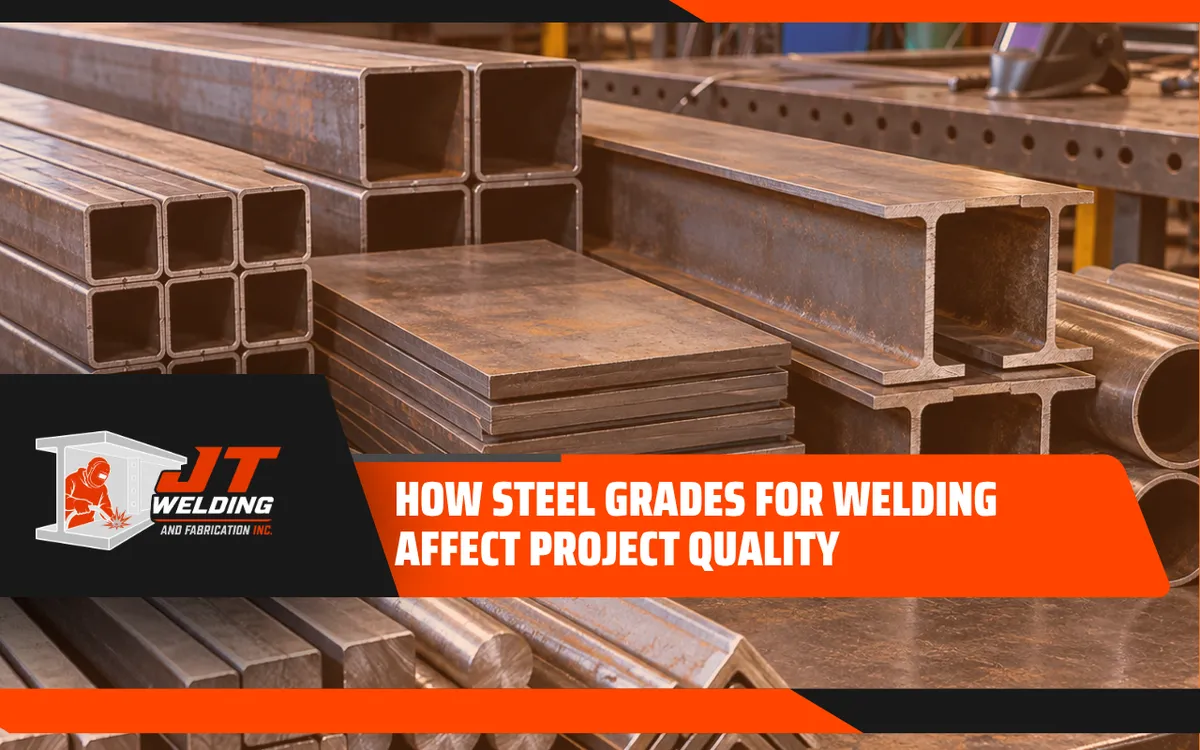
How Steel Grades for Welding Affect Project Quality
Selecting the right steel grades for welding is important when a structure must stay strong for years. The wrong choice can make welding harder, weaken joints, and create extra repair work. A good match helps the metal respond well to heat and supports safer results.
At JT Welding and Fabrication INC, we look at the metal, the job conditions, and the final use before welding begins. Understanding structural steel types, carbon steel weldability, and basic steel material properties makes the selection process clearer for many projects.
Main Steel Groups Commonly Used In Welding Projects
Steel used for welding usually falls into three groups: carbon steel, alloy steel, and stainless steel. Each reacts differently to heat, stress, and outdoor conditions. Knowing these differences helps narrow the options early.
Carbon steel is common, practical, and often easy to weld.
Alloy steel includes added elements that can increase strength or toughness.
Stainless steel contains chromium that helps protect against rust and corrosion.
Mild carbon steel is often easy to handle. Higher-carbon and alloy grades may need more heat control. Stainless steel suits jobs where corrosion is a concern.
Why Proper Steel Selection Supports Stronger Weld Results
Choosing suitable steel grades for welding affects strength, shape, and long-term performance. Steel material properties such as strength, flexibility, and heat expansion influence how the metal behaves during and after welding. A poor match can lead to cracking, bending, or weak joints.
Our team at JT Welding and Fabrication INC considers how the finished structure will be used. This matters for structural steel in Georgia, where outdoor steel may face heat, humidity, rain, and changing temperatures throughout the year.
Key Factors That Shape Your Steel Grade Choice
Several factors should guide steel selection. Beyond strength, consider how the material reacts during welding and how it will perform later.
Strength and flexibility should match the expected load.
Heat response should support clean, controlled welds.
Corrosion resistance should fit the work environment.
Metal compatibility matters when joining different materials.
These points make it easier to compare structural steel types and choose steel grades for welding that support the job without adding unnecessary difficulty.
Common Carbon Steel Grades For Fabrication Work Projects
Low-carbon steel is widely used because it has good carbon steel weldability and can handle many common welding methods. ASTM A36 is a familiar example for structural work because it combines practical strength with good flexibility.
Medium-carbon grades, such as AISI 1045, can offer more hardness, but they may need preheating to reduce cracking. High-carbon steels are harder again and usually require closer control of heat, filler metal, and cooling speed.
Alloy And Stainless Grades For Demanding Work Projects
Alloy steel can include nickel, chromium, or manganese to change strength, toughness, and wear resistance. Grades such as AISI 4140 and AISI 4340 may be useful when a project needs stronger performance, but careful heat control is often required.
Stainless grades such as 304 and 316 are common where corrosion resistance matters. Other grades, including 409 and 430, may fit different environments. With JT Welding and Fabrication INC, we match the welding approach to the grade instead of treating every steel the same.
Welding Methods Change Across Different Steel Grade Types
Different steel grades for welding may require different heat levels, speeds, and preparation. Low-carbon steel often works well with MIG, TIG, or stick welding. Higher-carbon or alloy steel may need preheating, while stainless steel often benefits from lower heat input.
Use proper preheat when the grade calls for it.
Match filler metal to the base material.
Control heat to reduce warping and cracking.
Inspect the finished joint for visible defects.
Good technique supports the selected grade. However, even skilled welding cannot fully correct a poor material choice.
Frequently Asked Questions
Which steel is easiest for general welding?
Low-carbon steel is often one of the easiest options because it reacts well to common welding methods and has good flexibility.
Does higher carbon always mean stronger steel?
Higher carbon can increase hardness and strength, but it can also reduce weldability and increase the chance of cracking.
Why does stainless steel need different heat control?
Stainless steel handles heat differently from carbon steel, so careful control helps limit warping and protect corrosion resistance.
Can different steel grades be welded together?
Yes, but the metals must be compatible. The filler material and welding method should also suit both base metals.
How do steel properties affect weld quality?
Strength, flexibility, expansion, and corrosion resistance can all affect how a joint forms and how it performs over time.
Better Steel Choices Lead To Reliable Fabrication Results
Choosing steel grades for welding with care helps support strong joints, cleaner work, and better long-term results. The best choice depends on strength needs, environmental exposure, heat response, and the welding process planned for the job.
At JT Welding and Fabrication INC, we use these factors to guide material decisions for practical fabrication work. By understanding carbon steel weldability, steel material properties, structural steel in Georgia, and steel grades for welding, we can build with greater confidence.