Welding Joint Types for Clean and Durable Connections
Welding joint types shape how metal parts fit, hold, and perform after welding. At JT Welding and Fabrication INC, we know that choosing the right joint can make work easier and help create stronger results.
Each joint has a different purpose. Some connect flat edges, while others join parts at corners or angles. Knowing the basic options can reduce mistakes, improve fit, and support safer, more reliable fabrication work.
Basic Welding Joints Every Fabricator Should Know Well
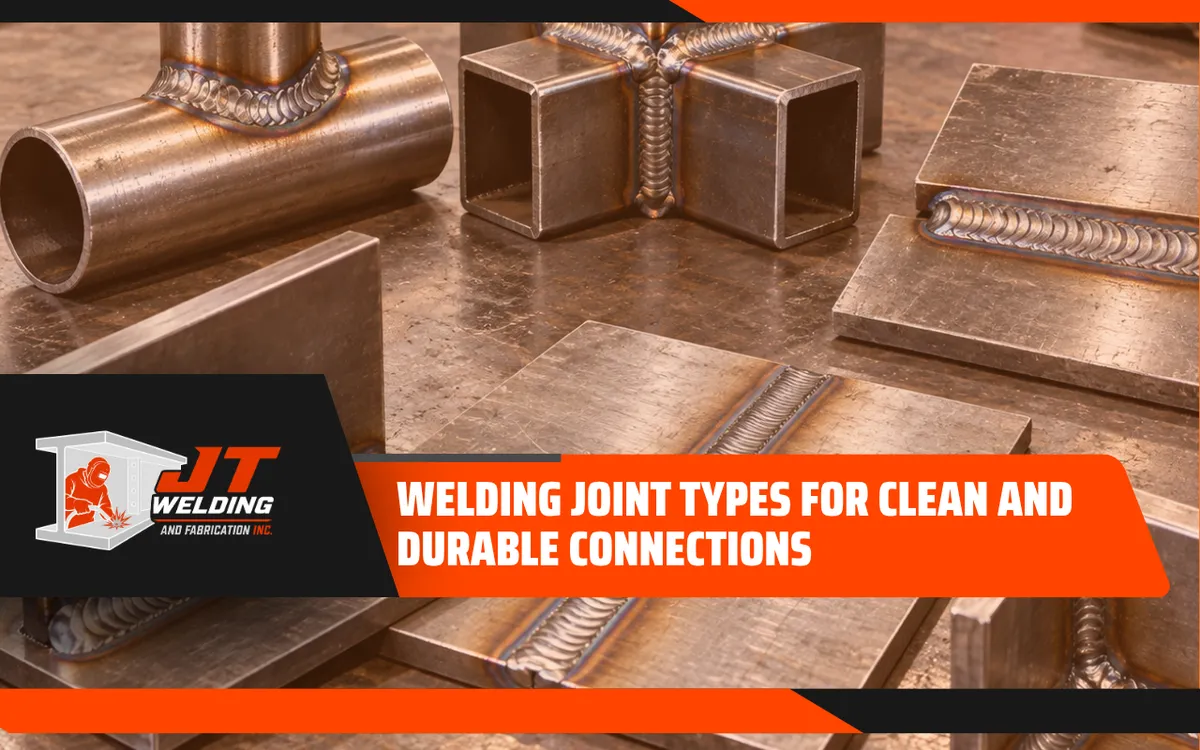
Most projects use five common joint forms: butt, lap, corner, T, and edge joints. Each one changes how the pieces meet and where the weld is placed. The right choice depends on the part shape, load, and material thickness. These welding joint types give fabricators a practical starting point for many projects.
Butt joints connect two edges on the same plane.
Lap joints place one metal piece over another.
Corner joints connect pieces near a right angle.
T-joints form a T shape between two parts.
Edge joints connect nearby edges along one side.
Right Joint Selection Supports Stronger Welding Results Overall
Choosing a joint should begin with the job requirements. Material thickness, load direction, access, and working conditions all matter. Good weld joint design also helps control heat, filler use, and the final weld shape.
At JT Welding and Fabrication INC, we focus on clear planning before welding starts. This approach can reduce extra work, limit weak areas, and make inspection easier after the connection is complete.
Butt Joint Welding Works Best With Proper Preparation
Butt joint welding joins two metal pieces along their edges. Clean surfaces and correct alignment are important because dirt, rust, or large gaps can weaken the connection. Clamps can also help keep both pieces steady during the weld.
Clean both edges before starting the weld.
Check alignment and keep the gap consistent.
Choose settings that match the metal thickness.
Depending on the project, MIG or TIG methods may be used. Thicker materials can also need edge preparation so the weld reaches deeper and forms a solid bond.
Fillet Weld Joints Connect Angled Parts With Strength
Fillet weld joints are common when two pieces meet at an angle, especially in T-joints, lap joints, and corner joints. The weld usually has a triangular shape that fills the area where the parts meet.
Good fit-up matters because uneven gaps can affect weld size and strength. Our team at JT Welding and Fabrication INC checks alignment, angle, and surface condition so the weld can form evenly and support the intended load.
Groove Weld Types Match Different Material Thickness Needs
Groove weld types are useful when parts need deeper weld penetration. Common forms include square, V, double-V, U, and bevel grooves. The best option depends on thickness, access, and how much preparation the joint needs.
Square grooves suit some thinner materials and simple setups.
V-grooves create space for deeper weld penetration.
Double-V grooves can balance welding on thicker pieces.
Bevel grooves work when one edge needs preparation.
Careful groove preparation can reduce wasted filler and help the weld reach the needed depth. It also supports more consistent results across larger fabrication jobs.
Common Joint Selection Mistakes Can Weaken Weld Quality
One common mistake is choosing welding joint types without checking material thickness. A joint that works well on thin metal may not suit a thick plate. Poor fit-up, large gaps, and dirty surfaces can also create weak areas.
Another mistake is ignoring access for welding and inspection. A joint may look good on paper but be difficult to reach in practice. Simple planning helps prevent rework and supports cleaner, more dependable connections.
Frequently Asked Questions
What are the most common welding joint types?
The five basic types are butt, lap, corner, T, and edge joints. Each has a different shape and is used for specific connection needs.
When is butt joint welding commonly used?
It is often used when two metal pieces meet edge to edge on the same plane, especially when a flat connection is needed.
Where are fillet weld joints normally used?
They are common in T-joints, lap joints, and corners where two metal surfaces meet at an angle.
Why do groove weld types have different shapes?
Different groove shapes help control weld depth, access, filler use, and preparation for materials of different thicknesses.
How does weld joint design affect quality?
It affects fit, heat flow, weld access, filler needs, and load support. A suitable design makes the welding process easier to control.
Better Joint Planning Leads To Reliable Welded Connections
Strong welding starts before the arc is struck. Welding joint types should match the material, load, position, and access available for the job. Proper cleaning, alignment, and setup then help the selected joint perform as intended.
At JT Welding and Fabrication INC, we value practical planning and careful workmanship. By combining the right joint with sound preparation, we can build cleaner connections, reduce avoidable rework, and support lasting fabrication results.